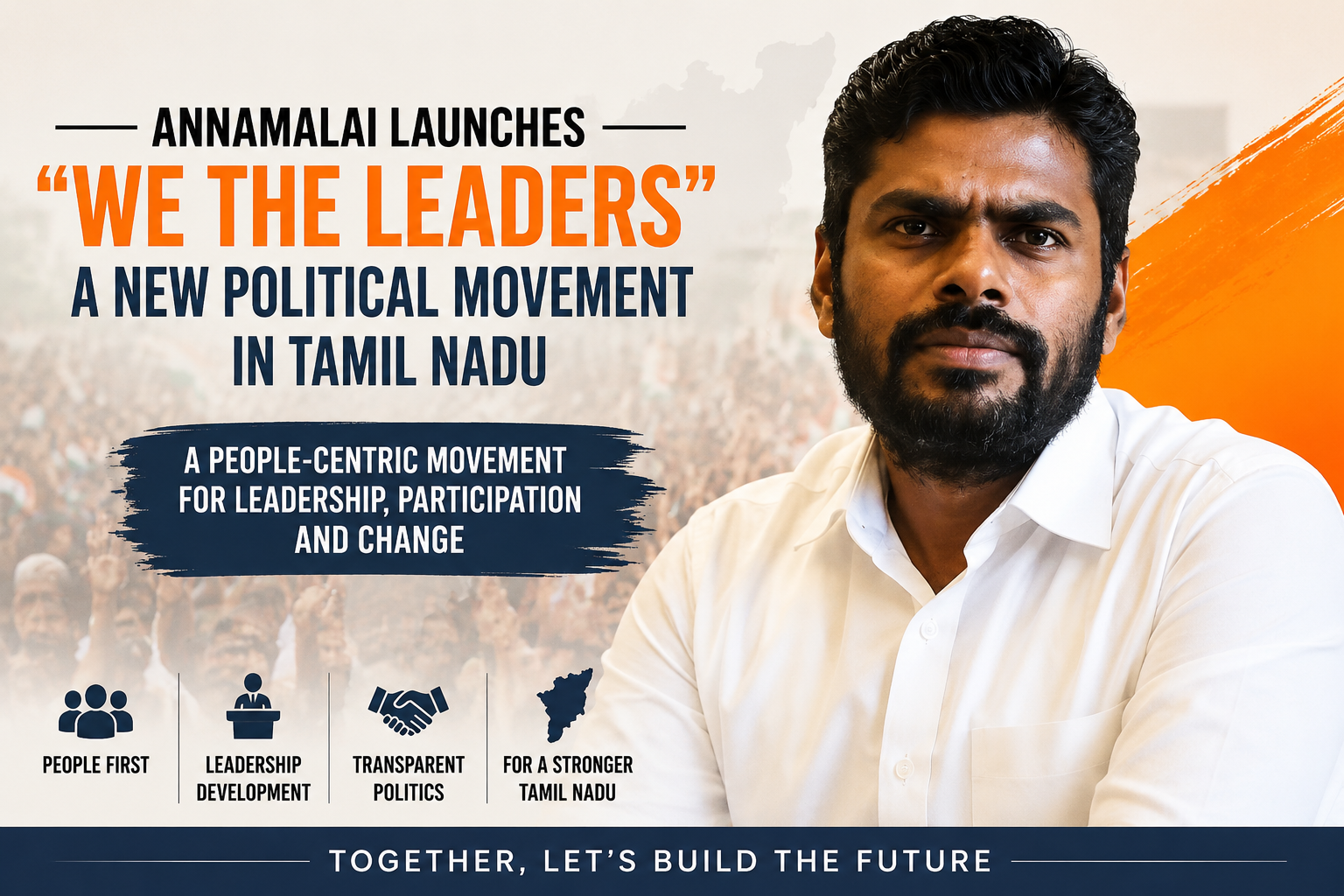
Annamalai Quits BJP & Launches
'We The Leaders' — Everything You Need to Know
Former Tamil Nadu BJP president K. Annamalai formally resigned from the party on June 5, 2026, and unveiled 'We The Leaders' — a grassroots political movement set to become a full party targeting the 2031 Tamil Nadu Assembly elections.
What Is the 'We The Leaders' Movement?
'We The Leaders' is a newly launched political movement by former Tamil Nadu BJP chief K. Annamalai, officially unveiled on June 5, 2026. The movement champions a shift away from personality-driven, dynasty-led politics towards a model Annamalai describes as "common-man politics" — a people-centric, grassroots-based alternative for Tamil Nadu.
Rather than forming a political party overnight, the movement is being built from the ground up, with plans to evolve into a full-fledged party before the 2031 Tamil Nadu Assembly elections. Membership enrollment is open at www.wetheleader.org, which Annamalai relaunched as part of the announcement.

Why Did Annamalai Leave the BJP?
Annamalai's exit from the BJP has been building since late 2025. He had informed the BJP leadership of his intention to leave as early as December 2025, but senior leaders requested that he stay until the Tamil Nadu election process was complete before formally stepping down.
The primary bone of contention was the BJP-AIADMK alliance for the 2026 elections. Annamalai had consistently argued that the BJP should contest the 2026 Tamil Nadu Assembly elections independently, rather than tie up with AIADMK under Edappadi K. Palaniswami. He also expressed frustration over being sidelined after stepping down as state president in April 2025.
"I am not someone who would sit in Tamil Nadu and simply send a resignation letter. That is why I met Amit Shah in person, shared the concerns and shortcomings that I felt existed, and then submitted my resignation."
— K. AnnamalaiIn his resignation letter, Annamalai praised Prime Minister Narendra Modi's leadership but acknowledged that his vision for Tamil Nadu had increasingly diverged from that of the BJP's central leadership. He also criticised what he described as cult politics and dynasty politics, taking a direct swipe at the ruling DMK government and Chief Minister M.K. Stalin.
Reasons for Annamalai's BJP Exit — At a Glance
- Disagreement over the BJP-AIADMK seat-sharing alliance for Tamil Nadu elections
- Belief that national parties struggle to understand Tamil Nadu's unique aspirations
- Opposition to personality-centric and dynasty-driven political models
- Desire to build an independent people-centric platform rooted in Tamil Nadu's identity
- Growing sense of marginalisation after stepping down as state president in April 2025
Key Timeline: Annamalai's Political Journey
After a celebrated career as a Karnataka-cadre IPS officer (nicknamed 'Singham'), Annamalai took voluntary retirement and returned to Tamil Nadu to pursue organic farming and social causes.
Joined the Bharatiya Janata Party and was rapidly elevated through party ranks due to his aggressive political outreach style.
Made state party president just 10 months after joining, becoming one of the fastest risers in the party's Tamil Nadu history. He covered all 234 assembly constituencies through his En Mann, En Makkal padayatra.
Stepped down as Tamil Nadu BJP president. Reports indicated the move was partly to ease tensions over the BJP-AIADMK alliance talks. Succeeded by Nainar Nagendran.
Formally communicated his intention to leave the BJP to senior leadership, but was requested to wait until after the electoral cycle.
After personally meeting Home Minister Amit Shah to explain his decision, officially resigned from the BJP and announced the 'We The Leaders' movement via a live video message to the public.
The Five Pillars of 'We The Leaders'
Annamalai has articulated a clear ideological foundation for the movement, one that deliberately contrasts with the Dravidian model of politics that has dominated Tamil Nadu for over six decades.
Ethical Leadership
Leaders with clean governance records and value-based decision-making at every level.
Grassroots Democracy
Build from the bottom up — district, taluk, and panchayat level engagement before state-level ambitions.
Common-Man Politics
Politics centred on the ordinary citizen's welfare, not on individual leaders or families.
Term Limits
Once the movement becomes a party, leadership positions will have fixed term limits to prevent dynastic entrenchment.
Transparency & Accountability
Open governance model with public audits, accountability frameworks, and anti-corruption commitments.

APJ Abdul Kalam Centre for Political Ethics — Coimbatore
One of the most concrete and distinctive announcements from the We The Leaders launch is the establishment of the APJ Abdul Kalam Centre for Political Ethics in Coimbatore district. Named after India's beloved former President and People's Scientist, this institution is at the heart of Annamalai's reform-focused vision.
🎯 Purpose: Training political candidates in ethical governance, transparent policy-making, and values-based leadership before they are fielded in elections.
🧑🎓 Focus: Every candidate fielded by the future We The Leaders party will mandatorily complete training at this centre.
Why the APJ Abdul Kalam Brand Matters
By naming the centre after Dr. APJ Abdul Kalam — a Tamil-born, nationally beloved figure associated with scientific achievement, simplicity, and integrity — Annamalai is making a pointed political statement. The association signals a clean break from the patronage-based, hereditary political culture that both DMK and AIADMK have been criticised for perpetuating. The centre is positioned as the institutional backbone of a new kind of Tamil Nadu politics.
Impact on Tamil Nadu's Political Landscape in 2026
Political analysts are already debating how We The Leaders will reshape the competitive environment in Tamil Nadu, particularly in the run-up to the 2026 Assembly elections and the longer-term 2031 electoral cycle. The movement's emergence disrupts a political field currently dominated by DMK (ruling), the AIADMK-BJP alliance (opposition), and emerging forces like actor Vijay's TVK.
Immediate Impact: Voter Sentiment & Narrative Shift
Even before formal party conversion, Annamalai's announcement reshapes the political narrative. His years as state BJP chief built him a considerable public following — particularly among urban youth, young professionals, and anti-establishment voters. His departure from the BJP sends a clear signal that Tamil Nadu's political landscape is fragmenting in new directions.
Long-Term Impact: The 2031 Election Equation
The movement's stated target of the 2031 Tamil Nadu Assembly elections gives it a five-year runway to build genuine grassroots presence across all 234 constituencies. If successful, We The Leaders could emerge as a significant third force, potentially drawing votes from disillusioned DMK supporters, post-AIADMK Dravidian voters, and BJP supporters in western Tamil Nadu.
Youth & First-Time Voter Appeal
Tamil Nadu has a significant demographic of first-time and young voters who are sceptical of both the Dravidian parties and national party templates. We The Leaders' messaging — term limits, common-man politics, ethical leadership — speaks directly to this cohort. The digital-savvy Annamalai, known for his direct social media engagement, is well-positioned to activate this base.
We The Leaders vs Traditional Tamil Nadu Parties
| Factor | We The Leaders | DMK | AIADMK |
|---|---|---|---|
| Leadership Model | Multi-leader, term-limited | Single-family centric | Single-leader centric |
| Ideology | Common-man politics, ethical governance | Dravidian socialism, social justice | Dravidian nationalism |
| Alliance Strategy | Independent (initially) | National alliances (INDIA bloc) | BJP-NDA alliance |
| Term Limits | ✓ Yes (planned) | ✗ No | ✗ No |
| Leadership Training | ✓ APJ Kalam Centre | ✗ No formal institution | ✗ No formal institution |
| Target Elections | 2031 TN Assembly | 2026 TN Assembly | 2026 TN Assembly |
| Core Base | Youth, urban professionals | OBC, minorities, urban voters | Rural, Thevar community |
Road Ahead: Plans, Milestones & 2031 Election Ambitions
Annamalai has been deliberate in framing We The Leaders as a patient, long-term project. He acknowledged that "it takes time to cure" and called for patience from supporters. The road to 2031 involves multiple structured phases.
Phase 1 — Movement Building (2026–2027)
- Nationwide membership enrollment via www.wetheleader.org
- District-level We The Leaders chapters across all 38 Tamil Nadu districts
- Launch of public consultation sessions and town-hall meetings
- Establishment of the APJ Abdul Kalam Centre for Political Ethics in Coimbatore
Phase 2 — Formal Party Conversion (2028–2029)
- Official registration as a political party with the Election Commission of India
- Announcement of party manifesto and core policy positions on key Tamil Nadu issues
- Internal elections for party leadership positions (with term-limit provisions baked in)
- Graduation of first batch of candidates from the APJ Kalam Centre training programme
Phase 3 — Electoral Debut (2030–2031)
- Fielding trained candidates across targeted constituencies in the 2031 Tamil Nadu Assembly elections
- Potential alliance or seat-sharing discussions with like-minded parties
- Focus on western Tamil Nadu constituencies where Annamalai has an existing voter base (Coimbatore, Erode, Karur belt)
Frequently Asked Questions (FAQ)
What is the 'We The Leaders' movement by Annamalai?
Why did Annamalai quit the BJP?
What is the APJ Abdul Kalam Centre for Political Ethics?
When will We The Leaders contest elections?
How can I join the We The Leaders movement?
What is Annamalai's background before politics?
Will We The Leaders take on the DMK government?
Conclusion: A New Era in Tamil Nadu Politics?
The launch of We The Leaders on June 5, 2026 is more than just one man leaving one party. It represents a meaningful challenge to Tamil Nadu's entrenched political order — an order built on decades of Dravidian dominance, family-controlled parties, and personality cults.
Whether Annamalai's vision of ethical, grassroots, common-man politics can translate into real electoral success by 2031 remains an open question. But the infrastructure he is building — the APJ Abdul Kalam Centre, the wetheleader.org membership drive, the five-year movement-to-party roadmap — signals that this is not a political statement but a serious political project.
For Tamil Nadu's voters, especially the growing cohort of young, educated, and disillusioned citizens, We The Leaders offers something that has been absent for a long time: the promise of politics built on accountability rather than ancestry.
Recent Comments